Marsala Quarry Park: A Hidden Gem Among Ancient Stone Quarries and Nature in Sicily
In Marsala, western Sicily, there is a place unlike the landscapes most visitors expect to find on the island. Towering stone walls, passages carved into the rock and Mediterranean vegetation growing among ancient quarry faces make Marsala Quarry Park one of the most unusual attractions in the province of Trapani.
Away from the beaches, vineyards and famous salt pans of Marsala, a remarkable landscape shaped by centuries of human activity awaits discovery.
Located in Contrada Sant’Anna, Parco delle Cave di Marsala (Marsala Quarry Park) is a former stone extraction site that has been transformed into a destination of historical, cultural and natural interest.
Here, stone is much more than a natural resource. It tells the story of generations of workers, traditional craftsmanship and the transformation of the Sicilian landscape.
Where Is Marsala Quarry Park Located?
Marsala Quarry Park is located at Contrada Sant’Anna 6/D, Marsala, in the province of Trapani, on the western side of Sicily.
The park occupies a former quarrying area that has been restored and opened to visitors.
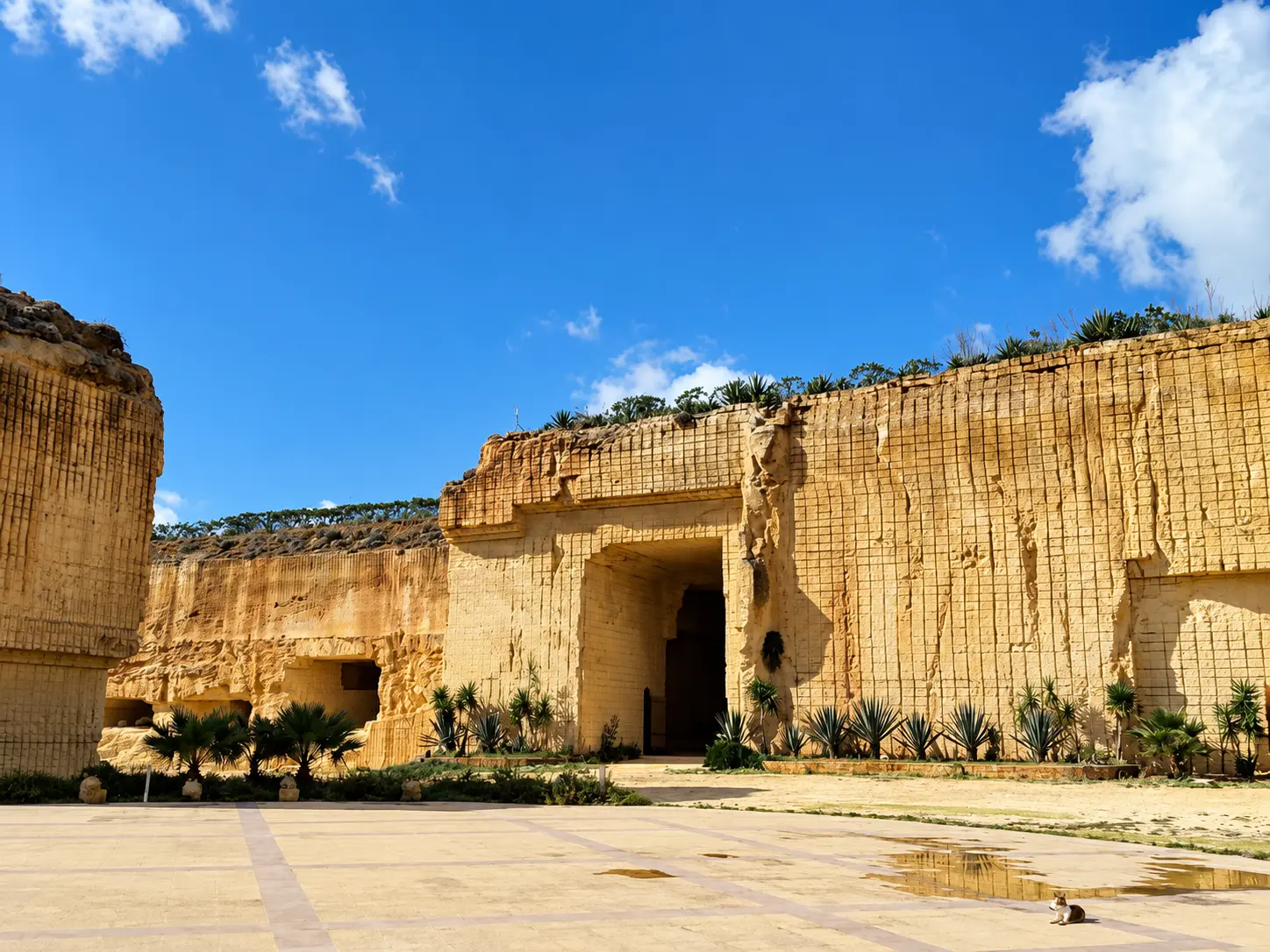
Its landscape is characterised by imposing vertical rock walls, geometrically shaped stone blocks, terraces and passages carved into the limestone.
The result is an extraordinary setting where traces of human activity blend with nature, creating unexpected views and fascinating contrasts.
The History of Marsala’s Ancient Stone Quarries
For centuries, stone extraction played an important role in Marsala’s local economy.
The material obtained from these quarries was commonly known as tufo (tuff), although geologically it is calcarenite, a type of sedimentary limestone widely used in construction.
The extracted blocks, locally known as cantuni, were used to build houses, churches, fortifications and other structures throughout the area.
The quarry workers, called cantunara or pirriaturi, were skilled craftsmen who specialised in cutting and shaping stone.
Their techniques and knowledge were passed down through generations, making quarrying an essential part of the region’s cultural and economic heritage.
Extracting the stone required considerable skill and precision. Workers had to identify suitable rock formations, cut the stone and produce regularly shaped blocks ready to be transported to construction sites.
Even today, the quarry walls preserve visible marks left by traditional extraction methods.
As new building materials became increasingly common, particularly during the twentieth century, many quarries gradually lost their economic importance and were abandoned.
From Abandoned Quarries to a Place Worth Discovering
The history of Marsala Quarry Park is also a story of environmental recovery and cultural preservation.
After quarrying activities ended, some of these sites faced years of neglect and deterioration.
Thanks to the efforts of private citizens, part of this heritage has been cleaned, restored and made accessible to visitors.
Today, the park offers a fascinating environment featuring paths on different levels, unpaved trails and passages through the rock.
The large calcarenite walls take on shades ranging from pale yellow to warm ochre, especially when illuminated by the Sicilian sun.
Their shapes and colours create striking contrasts with the blue sky and surrounding vegetation.
In certain areas, the landscape resembles a small canyon sculpted by human hands.
Nature Reclaims the Ancient Quarries
One of the most interesting features of Marsala Quarry Park is the relationship between its rocky landscape and the surrounding vegetation.
After the extraction activities were abandoned, nature gradually began to reclaim the area.
Plants found new spaces among the stone walls, cracks and terraces, creating a unique environment where human history and Mediterranean biodiversity coexist.
Today, visitors can observe several plants typical of the Mediterranean landscape, including Mediterranean dwarf palms, thyme and wild asparagus.
The rocky cavities and quarry walls also provide habitats for various bird species, including the colourful European bee-eater.
This combination of geological features, vegetation and wildlife makes the park interesting not only from a historical perspective but also for nature lovers.
What to See at Marsala Quarry Park
A visit to Marsala Quarry Park offers the opportunity to explore an unusual landscape and discover how traditional stone extraction transformed this part of Sicily.
Among the park’s most characteristic features are its towering limestone walls, ancient quarry faces, rock-cut passages and terraces connected by internal paths.
Visitors can observe the marks left by quarry workers and appreciate the impressive scale of the excavations.
The park offers guided tours, allowing visitors to learn about the history of stone extraction and understand the significance of the different areas.
It is a particularly appealing destination for photography enthusiasts, history lovers and travellers interested in discovering places beyond Sicily’s most popular attractions.
Opening Hours, Ticket Prices and Reservations
According to the information published on the park’s official website, Marsala Quarry Park can be visited throughout the year, with different opening hours depending on the season.
Winter opening hours (23 October – 30 April):
- Morning: 11:00 AM – 12:30 PM
- Afternoon: 3:30 PM – 5:00 PM
Summer opening hours (1 May – 22 October):
- Morning: 9:30 AM – 11:00 AM
- Afternoon: 6:00 PM – 7:30 PM
Visits are available by reservation only, and the last admission is scheduled 30 minutes before closing.
The listed admission price is €25 per person.
For further information and reservations, visitors can contact the park directly.
Address: Contrada Sant’Anna 6/D, Marsala (TP), Sicily, Italy
Phone: +39 329 8871413 / +39 333 4496861
Official website: https://www.parcodellecavemarsala.it/
Visitors are advised to check current opening hours, admission fees and availability before planning their visit.
Discovering a Different Side of Marsala
When people think of Marsala, images of its famous wine, salt pans, windmills and spectacular sunsets along the western Sicilian coast often come to mind.
However, moving inland reveals places that tell entirely different stories.
Marsala Quarry Park is one of them.
It demonstrates how a former industrial activity can become an opportunity to rediscover local traditions, craftsmanship and the history of a territory.
Its impressive stone walls, hidden passages and Mediterranean vegetation offer a perspective on Sicily that many visitors have never experienced.
Because Sicily is not only about famous monuments, beautiful beaches and well-known destinations. Sometimes, its most surprising stories are hidden in the places few people know about.
Photo credit: parcodellecavemarsala